Introduction
Welcome! This self-guided workshop is designed to help you better understand why you procrastinate and provide practical strategies to help you work through it.
The workshop is organized into three sections:
- Section 1: Why Do We Procrastinate?
- Section 2: Which Fear Is Driving Your Procrastination?
- Section 3: How to Work Through Procrastination
Because each section builds on the previous one, completing the workshop in order can help you develop a more comprehensive understanding of your procrastination patterns. However, this is not required. Please feel free to skip around, focus on the sections most relevant to you, and move through the workshop in whatever way best meets your needs.
You can return to Section 3 at any time as a practical toolkit and revisit the strategies whenever you need them.
Why Do We Procrastinate?
Watch this short video to learn what happens in your brain and body that can trigger procrastination.
Video Recap
1. Procrastination is often triggered by fear associated with a task.
The fear is not just about the task itself, but also about how we interpret the challenges associated with the task and how those interpretations impact how we evaluate ourselves. For example, we may worry about failing, making mistakes, or what the outcome says about our abilities.
2. This fear evokes our fight, flight, or freeze response.
Procrastination is essentially the flight response that we are all wired to have. Rather than confronting the source of fear, our brain encourages us to escape it, often by turning to something that feels easier or more rewarding in the moment.
3. The tricky part is that procrastination works, at least temporarily.
Avoiding the task reduces feelings of stress and anxiety, providing a brief sense of relief. Because our brain experiences that relief as a reward, it becomes more likely to choose avoidance the next time a similar task triggers fear.
4. Procrastination forms a cycle.
Even though we rationally know procrastination often creates more stress in the long run, our brain learns that avoidance brings immediate relief, making the habit difficult to break.
Which Fear Is Driving Your Procrastination?
Most often, the flight response kicks in automatically, and we begin procrastinating without realizing what underlying fear we're trying to avoid. The first step to breaking the procrastination cycle is to understand the fear that triggers your procrastination and map it out.
In this section, we'll talk about how we internalize messages about toxic productivity from our environment and the core beliefs we develop about ourselves that evoke those fears and trigger the flight response. At the end, we'll map out your procrastination cycle together!
Internalized Toxic Productivity
Many of us grow up surrounded by messages that tie our worth to our productivity and achievements. Listen to the audio below to learn how the cycle of toxic productivity may contribute to procrastination.

Schema (our core beliefs about ourselves and the world)
Click here to listen to the audio for this section:
Schemas are our core beliefs about ourselves, others, and the world. They are often shaped by our past experiences and continue to influence how we think, feel, and respond to new situations.
Think of a schema as a pair of sunglasses. The lenses change how we see it, and in the same way, schemas act as mental filters that shape how we interpret ourselves, other people, and the world around us. The tricky part is that we often forget we're wearing the "sunglasses." Instead of recognizing that our schemas are influencing our perspective, we assume what we see is reality.
When a schema is activated, it can shape how we evaluate a challenge and whether our brain perceives it as threatening. Check out the list of common schemas and identify the schema that has contributed to the fear that fuels your procrastination (common triggers are highlighted).
Adapted from the Getting Unstuck Workshop Materials from Cal Poly.
Map out How Your Fear Triggers Your Procrastination
Listen to the audio for this section:
Many times, our schemas are activated automatically, and the chain reaction unfolds like a row of falling dominoes—often completely outside of our awareness. Before we realize it, we've interpreted the situation, experienced fear, and begun procrastinating.
Recognizing what is happening in your body and mind is the first step toward breaking the procrastination cycle. Once you map out how your fear leads to procrastination, you'll have a clear roadmap for choosing strategies that target the parts of the cycle you want to change in the next section.
Below is an example of how to map out the chain reaction that leads to procrastination. Then, use the blank Worksheet for the Procrastination Chain Reaction to create your own map.
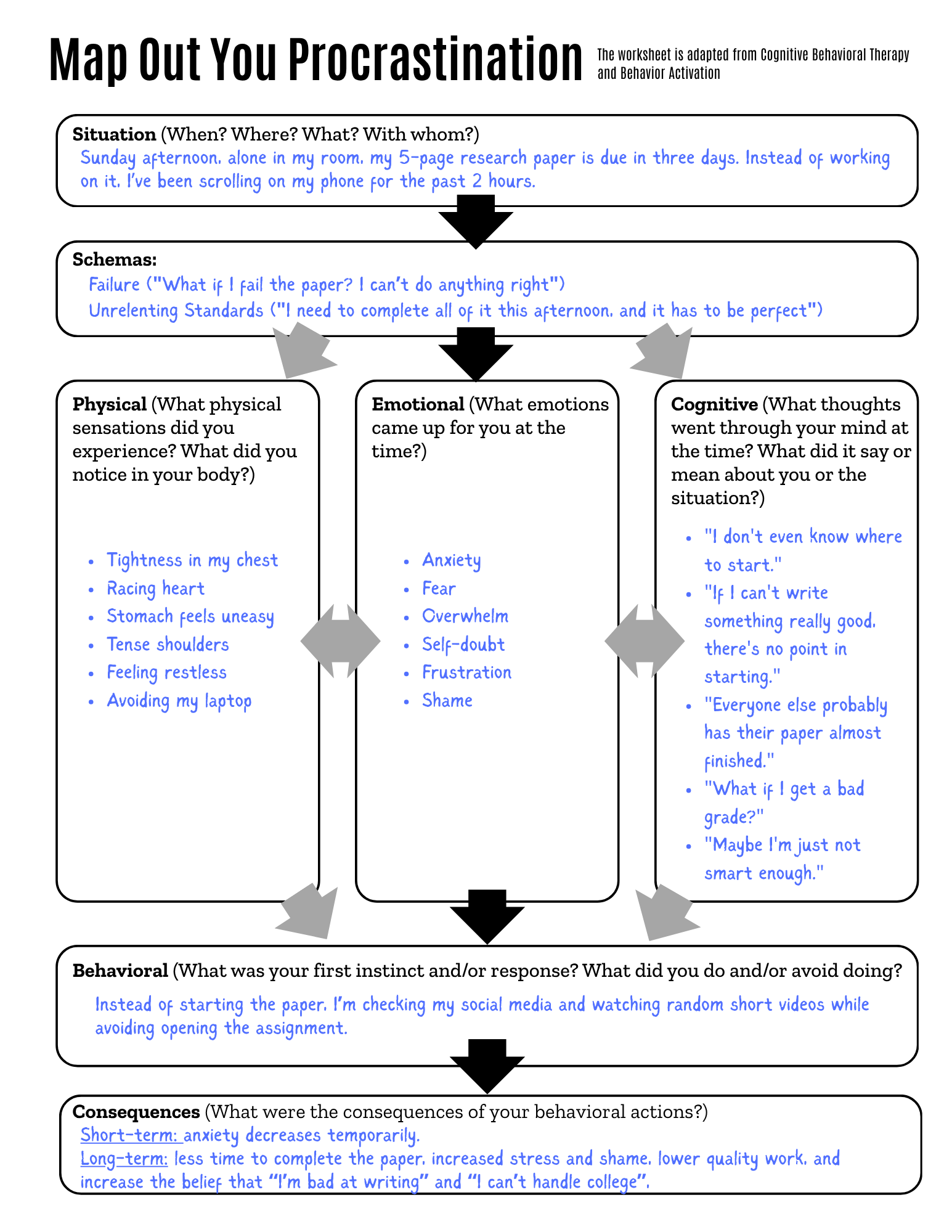
Adapted from the Getting Unstuck Workshop Materials from Cal Poly.
What if it is NOT fear?
Listen to the audio for this section:
So far, we've focused on fear-driven procrastination, but it's important to recognize that not all procrastination is driven by fear.
Sometimes, procrastination is a sign of fatigue or burnout. For example, after a long day of classes or work, you may struggle to cook dinner or do laundry. You probably don't feel afraid of cooking or washing your clothes, yet you still find yourself scrolling on your phone instead of getting started.
In these moments, procrastination is often less about fear and more about mental exhaustion. After making countless decisions throughout the day, your brain may simply have limited energy left to initiate another task. If you find yourself in this situation frequently, here are two things to consider:
1. Build in a transition for self-care.
Your brain needs time to recharge before moving on to the next task. Consider creating a short transition routine when you get home, such as taking a shower, stretching, having a snack, or simply sitting quietly for a few minutes before tackling household chores.
2. Work with your energy, not against it.
When your mental energy is low after a long day, it may not be the best time to tackle tasks like doing laundry or cooking a meal from scratch. Instead of forcing yourself to complete these tasks when you're exhausted, consider scheduling the bulk of them for times when you have more energy. For example, you might do your laundry or do your meal preparation on the weekend when you're better rested, making weekday evenings less demanding and more manageable.
3. Address both the procrastination and the burnout.
The strategies in the following sections may still help you get started on tasks, even when you're feeling mentally drained. However, if burnout is the primary driver of your procrastination, it's equally important to build sustainable self-care practices that allow you to rest, recover, and prevent burnout over time.
How to Make Changes
Listen to the audio to follow along:
Now that we understand what happens in our body and mind before and during procrastination, let's talk about how to break the cycle.
Although procrastination provides temporary relief from stress, the work doesn't disappear. In the back of our mind, we still know the task is waiting for us and that the deadline is getting closer. As time passes, procrastination becomes less effective at reducing our stress, while our anxiety, guilt, and pressure continue to build.
The graph below illustrates what this experience often looks like (Clear, n.d,). During procrastination, our emotional distress gradually increases. It reaches its highest point right before we finally begin the task. Ironically, once we get started and begin making steady progress, our stress often drops much more quickly than we expect.
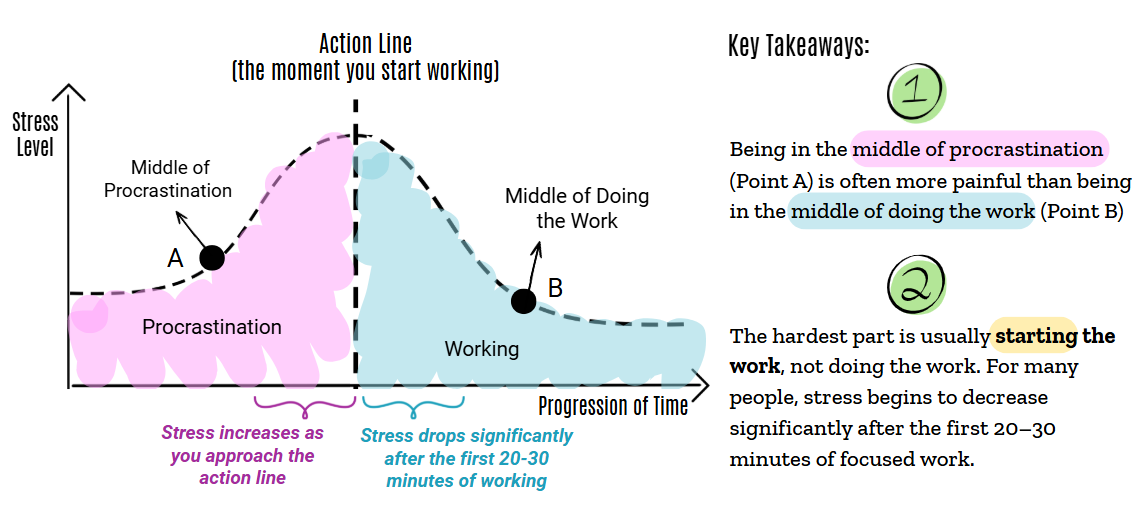
Figure 1: The Procrastination-Action Line. Adapted from James Clear (jamesclear.com).
Utilizing the Skills to Make Changes
All of the skills below are designed to help you get through the action point and the first 20–30 minutes of working, because this is often the most emotionally difficult part of the process. Once you start the work, your stress will drop significantly. This is because you often discover that:
- The task is not as overwhelming or impossible as your fear predicted, and
- You are making progress and are more capable than you initially believed.
Use the Procrastination Chain-reaction Worksheet you filled out in the last section to decide which technique to start.
Cognitive Techniques (coping with racing thoughts)
Stop Self-blaming
If you remember what we discussed in the first section, procrastination is a flight response that our brains are wired to use when something feels threatening. Procrastination is NOT a sign of laziness or poor self-discipline. Everyone procrastinates (yes, even us therapists!).
Unfortunately, self-blame and shame only fuel the internalized toxic productivity, making the procrastination cycle even stronger. If you notice yourself criticizing or blaming yourself for "being lazy," "being weak-minded," "lacking self-discipline," or "wasting time," try the following exercise to help you let those thoughts go.
Give Yourself Permission to Make Mistakes
Fear of failure and not meeting perfectionistic standards often triggers procrastination. Lowering the bar and giving yourself permission to intentionally do something imperfectly can help reduce that fear and make it easier to get started. For example:
| Instead of... | Say... |
|---|---|
| "I need to do it perfectly." | "I can do it really badly the first time, and then I'll go back and edit it." |
| "I need to spend the next four hours completing this assignment." | "I'm only going to work on this for 20 minutes. If I don't want to continue after that, I can take a break." |
One example of this strategy for writing is the "word vomit" technique. Here's how it works:
Step 1: At the beginning of your writing assignment, spend 20 minutes dumping every idea you have onto the page without censoring yourself. Don't worry about grammar, organization, or writing complete sentences. Your goal is simply to create a "bad" first draft. Bullet points, incomplete sentences, and random thoughts are all welcome.
- Step 2: After 20 minutes, you'll likely notice that your anxiety has decreased. More importantly, you now have something to work with. Instead of facing a blank page, you have a rough draft that you can begin organizing, editing, and turning into complete sentences.
Emotional Technique (coping with uncomfortable feelings)
What is That Feeling?
Instead of immediately trying to avoid or escape your stress, take a moment to identify what you're feeling. Emotions need to be acknowledged before they can begin to settle. When we ignore or suppress them, they often keep trying to get our attention.
Use the exercise below to practice noticing, naming, and observing your emotions without judging or trying to change them: Mindfulness of Current Emotions (4 minutes).
Calm Your Mind
As you get closer to the Action Line, your fear and anxiety may become more intense. If the intense feelings is preventing you from starting the task, take a few minutes to help your body and nervous system settle. Practicing one or more of the exercises below can make it easier to take that first step.
Behavioral Techniques (coping with the avoidance)
Setting the Smallest Possible Goals
Breaking a task into smaller steps is an effective way to reduce the anxiety of getting started. Smaller tasks feel more manageable, making us more likely to begin and accomplish them. If starting feels especially difficult, try breaking the first 20 minutes of the task into 8–10 of the smallest possible steps. This can make it much easier to get past the Action Line. Once you're engaged in the task, your anxiety will often begin to decrease naturally.
For example, if you've been procrastinating on writing a paper, instead of setting a goal to finish the paper in three hours, break the first 20 minutes into 8–10 mini-goals, with only one action in each step:
- Goal 1: Open your laptop.
- Goal 2: Open a Word document.
- Goal 3: Type your course number and name at the top of the document.
- Goal 4: Open the assignment prompt.
- Goal 5: Copy and paste the prompt into your document. (You don't need to read it yet.)
- Goal 6: Read the prompt. (You don't need to write anything yet.)
- Goal 7: Set a timer for 20 minutes.
- Goal 8: Practice the Word Vomit Technique (see Cognitive Techniques).
Social Accountability
Messages about toxic productivity often emphasize the importance of self-discipline. However, relying solely on self-discipline requires a great deal of mental energy and can be difficult to sustain. A more effective approach is to modify your environment so that it naturally supports the behaviors you want.
One strategy is body doubling, which can increase accountability and reduce avoidance. Depending on what works best for you, body doubling might look like:
- Studying in a public space, such as a library, café, or park.
- Body doubling virtually through FaceTime, Zoom, or an online virtual study room.
- Body doubling in person with a friend or by joining a study group.
Pairing with Something Smoothing
Another helpful strategy is to pair a task you've been avoiding with something calming or enjoyable. This can reduce the emotional discomfort associated with getting started.
For example:
- Listen to your favorite music or a concert recording while working.
- Light a scented candle or diffuse a favorite scent.
- Play calming background music.
- Work from the couch instead of your desk if that helps you feel more comfortable. (However, try to reserve your bed for sleep only.)
Additional Resources
If you have ADHD and/or other executive functioning differences, task initiation may be more difficult. Check out these additional resources to help with task initiation and concentration:
We'd love to hear feedback about this workshop or your needs for similar self-help workshops. Please fill out this feedback survey by clicking here.
Reference:
Cal Poly (n.d.). Getting Unstuck Workshop.
Clear, J. (n.d.). The procrastination-action line [Digital image]. James Clear. jamesclear.com